Ivins history ·
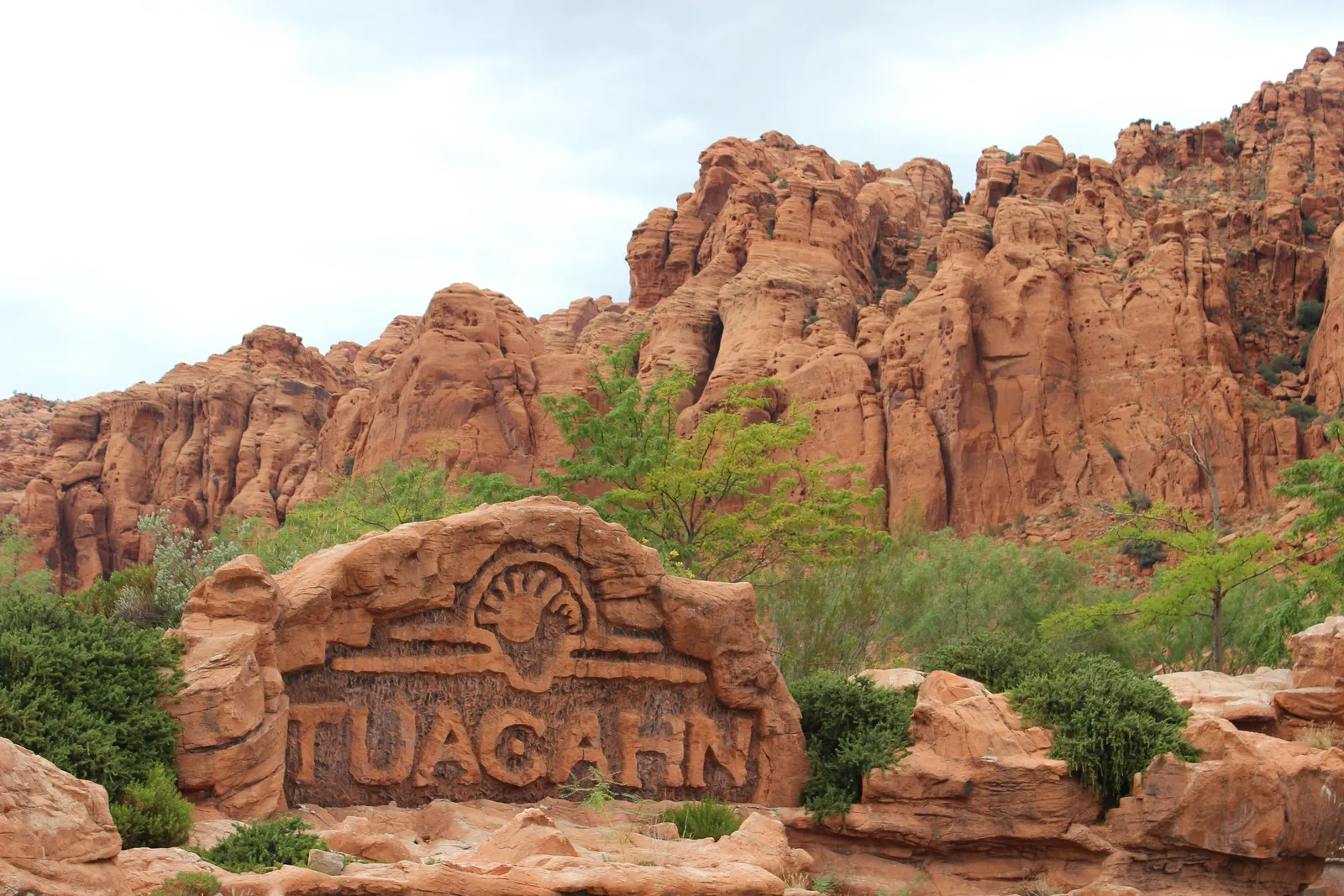
Tuacahn Center for the Arts sits at 1100 Tuacahn Drive, at the top of Padre Canyon on the north side of Ivins. It opened in 1995, after about four years of fundraising, construction and one legal fight over desert tortoises. This is how it came together. (Tuacahn)
1983–1991: The search for a stage
Playwright Doug Stewart, who wrote the script for “Saturday’s Warrior” and the screenplay for “Where the Red Fern Grows,” moved to St. George with his wife, Mary, and their eight children in 1983. He liked to ride a moped into the red-rock canyons around town, looking for a natural amphitheater for a large outdoor show. (Deseret News, 2010)
In August 1991 he parked near the cliffs just around the corner from Snow Canyon and walked up a wash. About a mile and a half in, he reached the end of a box canyon and decided it was the place. (Deseret News, 2010) Tuacahn’s own history also dates the idea to 1991 and describes a setting with 1,500-foot red cliffs. (Tuacahn)
Where the name came from
Stewart made up the name. In 1995 the Deseret News said he based it on a Mayan phrase meaning “canyon of the gods.” (Deseret News, 1995) Tuacahn says the name was inspired by “Teotihuacan,” which it translates as “city of the gods,” and was meant to stand for “canyon of the gods.” (Tuacahn)
Buying the canyon
Tuacahn credits Orval Hafen as the original owner of Padre Canyon. (Tuacahn) When Stewart went to buy it, the 80 acres he wanted belonged to a group of investors from Bountiful, who were asking $300,000. (Deseret News, 2010)
Before he had even found the site, Stewart had a $10,000 check from St. George arts supporter Rex Meikle. After the canyon was chosen, Rick and Peg Young gave $50,000. The breakthrough came when Stewart took Hyrum W. Smith of Franklin Quest out to see the canyon. Smith committed the full $300,000 on the spot, and a year later the Smith family committed $10 million more to underwrite the nonprofit project. (Deseret News, 2010) Tuacahn names Hafen, Stewart and Smith as the three people it was built on. (Tuacahn)
1994: Tortoises on the access road
The center was developed privately by the Heritage Arts Foundation, a nonprofit. (Deseret News, 1995) The road into the site crosses desert tortoise habitat, and the tortoise had been listed as a threatened species under the federal Endangered Species Act in 1989. Two tortoises were killed by vehicles on the road during construction. The foundation had started building before Washington County had a federal permit covering tortoise habitat, so the deaths violated the act. (U.S. Department of Justice, 1994)
On Aug. 18, 1994, the Justice Department announced a settlement on behalf of the U.S. Fish and Wildlife Service that let construction go ahead. The foundation agreed to pay $20,000 in restitution, take steps to prevent more deaths and apply for its own incidental take permit. (U.S. Department of Justice, 1994) A fence was later built along the road to keep tortoises off it. (Deseret News, 1995)
April 1995: Dedication
The finished center covered 80 acres in box-shaped Padre Canyon, about 10 miles northwest of St. George. Along with the outdoor amphitheater, it had an indoor theater, classrooms and studios. (Deseret News, 1995)
On Saturday, April 8, 1995, President Gordon B. Hinckley of The Church of Jesus Christ of Latter-day Saints offered the dedicatory prayer, and the Mormon Tabernacle Choir sang hymns. In his remarks, Stewart quoted Spencer W. Kimball: “Blessed is the man with a dream and new worlds to conquer.” Foundation president Hyrum Smith welcomed the crowd with a joke: “We hope you did not disturb the turtles on your way in.” (Deseret News, 1995) Tuacahn says Stewart heard the choir warming up that day, four years after he first stood in the canyon. (Tuacahn)
“Utah!” and a real flood
The first show in the amphitheater was “Utah!,” a production about the area’s ancient people and pioneer settlers, which ran for four years. (Tuacahn) The amphitheater was built to re-create the Santa Clara River flood of 1862. (Deseret News, 1995)
On Sept. 6, 1995, a monsoon storm pushed a 5-foot wall of red mud and water into the amphitheater, the Black Box Theater, the Hafen Theater and several classrooms. Mary Stewart, director of the Tuacahn School of the Arts, said mud, water and debris reached Row H, and that the phone lines were jammed with people offering to help. The debris also knocked down the tortoise fence and closed the road. (Deseret News, 1995)
Less than two years after the 1995 opening, Doug Stewart left the project. (Deseret News, 2010)
1999 and after: Broadway in the canyon
In 1999 Tuacahn replaced “Utah!” with “Joseph and the Amazing Technicolor Dreamcoat” and “Seven Brides for Seven Brothers.” Both drew big crowds, and Tuacahn calls that season the start of “Broadway in the Canyon.” (Tuacahn)
The same year, Tuacahn High School for the Performing Arts opened in the canyon. It was Utah’s first charter high school. It closed in 2021, and its charter was transferred to the Utah Arts Academy. (Utah State Archives)
Tuacahn lists these later milestones: (Tuacahn)
- 2005: Scott Anderson is hired as artistic director.
- 2008: Tuacahn is one of the first regional theaters given the rights to produce “Les Misérables.”
- 2010: It becomes the first licensed regional theater outside Broadway to produce Disney’s “Tarzan.”
- 2019: Gov. Gary R. Herbert declares Sept. 27 “Tuacahn Day” in honor of Hyrum and Gail Smith.
Tuacahn says it has produced more than 60 Broadway shows since 1999. (Tuacahn)
Sources
- Lee Benson, “Tuacahn born of a dream,” Deseret News, Aug. 13, 2010
- Helen Gardner, “Tuacahn center is dedicated as a beacon of entertainment,” Deseret News, April 10, 1995
- Helen Gardner, “Storm sends wall of red mud into Tuacahn amphitheater,” Deseret News, Sept. 7, 1995
- U.S. Department of Justice, “Heritage Arts Foundation agrees to protect desert tortoises,” Aug. 18, 1994
- Tuacahn Center for the Arts, “Tuacahn Unveiled: Honoring Our Rich Heritage on Tuacahn Day”
- Utah Division of Archives and Records Service, Utah Arts Academy (formerly Tuacahn High School for the Performing Arts)